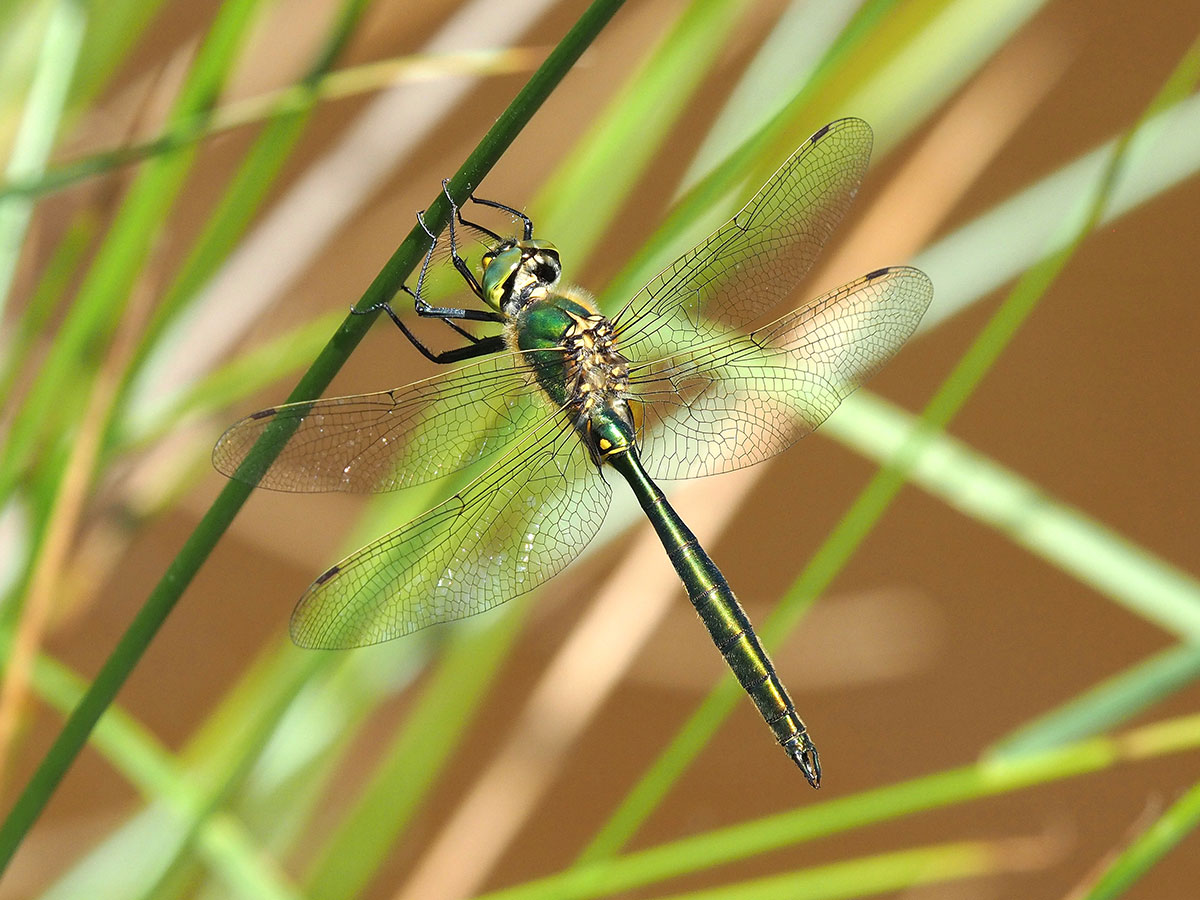
This national rarity differs from the Downy Emerald in a few subtle respects. It is larger and looks a brighter green in flight. It flies faster and more purposefully, with less turning and pausing, and tends to stick close to the trees and in the shade. Close examination is needed to separate the two species.
National status
Rare. Two widely separated and disjunct populations, south-east England and the Scottish Highlands. Some of the most significant southern populations occur in Sussex. IUCN categorises the Brilliant Emerald as endangered in the UK.
Status in Sussex
Local. Concentrated on the northern woodland ridges of the High Weald and in the Low Weald along the upper Ouse, with a few outliers including the upper Arun river catchment. Listed in the Sussex Rare Species Inventory.
Distribution at 1km scale
Historical records
According to Bloomfield (1910), the finding of this species by E. Speyer at a site near Tunbridge Wells in August 1908 was the first record for Sussex. However, Dannreuther (1939) listed an earlier record by W. Lucas in 1900, at Crowborough. By the time of the 1965-1978 survey, and within its habitat constraints, it appears to have become relatively common (Chelmick 1979).
Flight times
Early June - late August.
Phenology (adult)
1 / 1
Brilliant Emerald habitat at Old Lodge, Ashdown Forest Photo: Simon Linington
Habitat
Similar to that of the Downy Emerald: mildly acidic, usually large, still, relatively vegetation-free-water bodies, often set in pine woodland with sheltered bays and overhanging trees and bushes.
Conservation
Maintaining large ponds and lakes in the northern heathy belt of the county will help this species. Its larvae live in the detritus of dead leaves, twigs and other vegetation. To improve many larger ponds for fishing, dredging and the removal of bankside cover is often carried out so raising awareness of the consequences among anglers is important.
Similar species
For identification differences from Downy Emerald please see the species page for that species.
This national rarity differs from the Downy Emerald in a few subtle respects. It is larger and looks a brighter green in flight. It flies faster and more purposefully, with less turning and pausing, and tends to stick close to the trees and in the shade. Close examination is needed to separate the two species.
1 / 6
ovipositing female Photo: David Sadler
2 / 6
teneral female Photo: David Sadler
3 / 6
female Photo: David Sadler
4 / 6
male Photo: David Sadler
5 / 6
male Photo: David Sadler
6 / 6
male Photo: David Sadler
National status
Rare. Two widely separated and disjunct populations, south-east England and the Scottish Highlands. Some of the most significant southern populations occur in Sussex. IUCN categorises the Brilliant Emerald as endangered in the UK.
Status in Sussex
Local. Concentrated on the northern woodland ridges of the High Weald and in the Low Weald along the upper Ouse, with a few outliers including the upper Arun river catchment. Listed in the Sussex Rare Species Inventory.
Distribution at 1km scale
Historical records
According to Bloomfield (1910), the finding of this species by E. Speyer at a site near Tunbridge Wells in August 1908 was the first record for Sussex. However, Dannreuther (1939) listed an earlier record by W. Lucas in 1900, at Crowborough. By the time of the 1965-1978 survey, and within its habitat constraints, it appears to have become relatively common (Chelmick 1979).
Flight times
Early June - late August.
Phenology (adult)
1 / 1
Brilliant Emerald habitat at Old Lodge, Ashdown Forest Photo: Simon Linington
Habitat
Similar to that of the Downy Emerald: mildly acidic, usually large, still, relatively vegetation-free-water bodies, often set in pine woodland with sheltered bays and overhanging trees and bushes.
Conservation
Maintaining large ponds and lakes in the northern heathy belt of the county will help this species. Its larvae live in the detritus of dead leaves, twigs and other vegetation. To improve many larger ponds for fishing, dredging and the removal of bankside cover is often carried out so raising awareness of the consequences among anglers is important.
Similar species
For identification differences from Downy Emerald please see the species page for that species.


-Brilliant-Emerald.jpg)