This common, tawny to dark brown species is easy to identify. All four wings have a dark mark at the node, from which the species derives its name, and the hindwings in particular have a conspicuous dark patch at their base. Both males and females have a predominantly brown thorax and abdomen, the tip of which is black. Fine hairs cover the thorax. The males are highly territorial.
Status in Sussex
Patchily distributed and locally common across the county, especially on Wealden Greensand, and in High Weald localities such as Ashdown Forest. On Pevensey Levels, the number of records has reduced during the two decades up to 2020 though this may well be due to reduced observer coverage. During this time, the species has consolidated its distribution in the far east of Sussex.
Distribution at 1km scale
Historical records
Dannreuther (1941) made no mention of Sussex in his “Preliminary note on dragonfly migration” in which he described the well recorded migration of this species across Europe, including landfalls of thousands of insects in Kent (see also Parr 1996). Although locally abundant in its favoured habitats, the 1965-1978 survey map displayed many gaps across the county (Chelmick 1979), which are still present, but reduced.
Flight times
Early May - mid August.
Phenology (adult)
1 / 1
Four-spotted Chaser habitat at Old Lodge, Ashdown Forest (drought affected pond in Aug 2020) Photo: Simon Linington
Habitat
A wide range of mainly still, acid waters, from bog pools on heathland, to pits and ponds. Occasionally found on slow-flowing streams.
Conservation
More needs to be discovered about the particular requirements of this species, as it has a patchy distribution in the county, found in some sites of a characteristic habitat, but absent from others. As with other acid pool dwellers, maintaining open heath and associated water-bodies, preventing scrub invasion and creating new ponds, will all benefit this species.
Similar species
This species if seen well is unlikely to be confused with other Sussex species. However, see Scarce Chaser for a discussion of identification of female Chasers and Skimmers.
This common, tawny to dark brown species is easy to identify. All four wings have a dark mark at the node, from which the species derives its name, and the hindwings in particular have a conspicuous dark patch at their base. Both males and females have a predominantly brown thorax and abdomen, the tip of which is black. Fine hairs cover the thorax. The males are highly territorial.
1 / 8
teneral and exuvia Photo: David Sadler
2 / 8
teneral female Photo: David Sadler
3 / 8
female Photo: David Sadler
4 / 8
male Photo: David Sadler
5 / 8
male Photo: Simon Linington
6 / 8
male Photo: Simon Linington
7 / 8
male Photo: Simon Linington
8 / 8
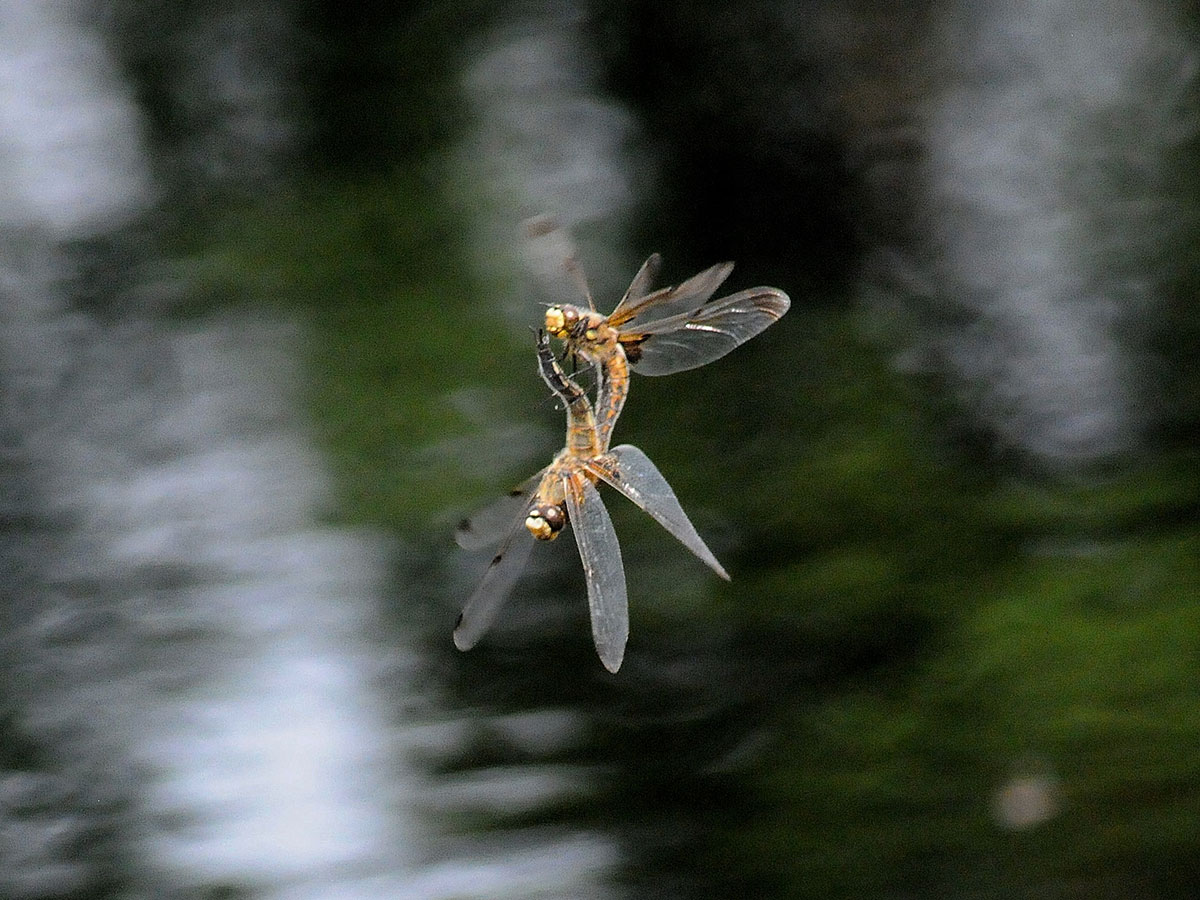
mating Photo: David Sadler
National status
Common throughout Britain.
Status in Sussex
Patchily distributed and locally common across the county, especially on Wealden Greensand, and in High Weald localities such as Ashdown Forest. On Pevensey Levels, the number of records has reduced during the two decades up to 2020 though this may well be due to reduced observer coverage. During this time, the species has consolidated its distribution in the far east of Sussex.
Distribution at 1km scale
Historical records
Dannreuther (1941) made no mention of Sussex in his “Preliminary note on dragonfly migration” in which he described the well recorded migration of this species across Europe, including landfalls of thousands of insects in Kent (see also Parr 1996). Although locally abundant in its favoured habitats, the 1965-1978 survey map displayed many gaps across the county (Chelmick 1979), which are still present, but reduced.
Flight times
Early May - mid August.
Phenology (adult)
1 / 1
Four-spotted Chaser habitat at Old Lodge, Ashdown Forest (drought affected pond in Aug 2020) Photo: Simon Linington
Habitat
A wide range of mainly still, acid waters, from bog pools on heathland, to pits and ponds. Occasionally found on slow-flowing streams.
Conservation
More needs to be discovered about the particular requirements of this species, as it has a patchy distribution in the county, found in some sites of a characteristic habitat, but absent from others. As with other acid pool dwellers, maintaining open heath and associated water-bodies, preventing scrub invasion and creating new ponds, will all benefit this species.
Similar species
This species if seen well is unlikely to be confused with other Sussex species. However, see Scarce Chaser for a discussion of identification of female Chasers and Skimmers.


-Four-spotted-Chaser.jpg)