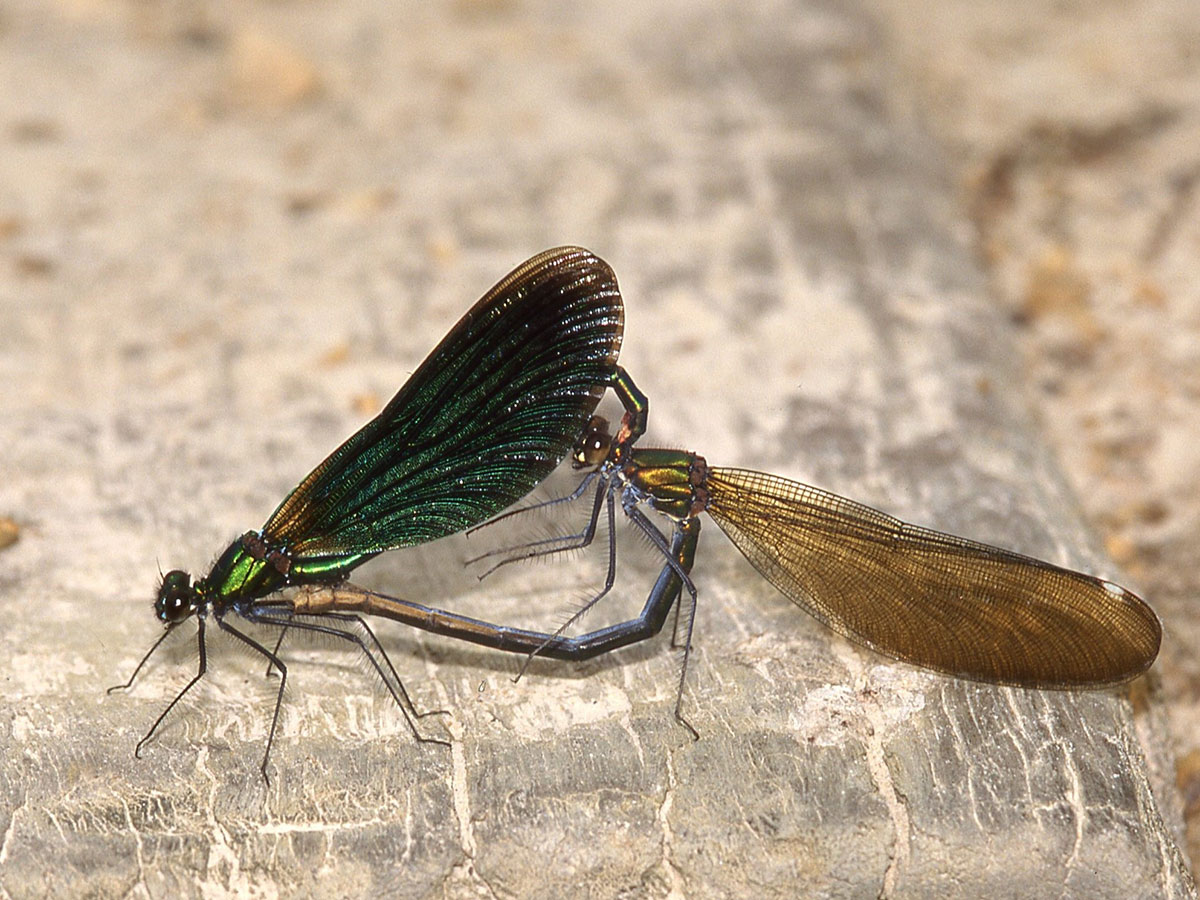
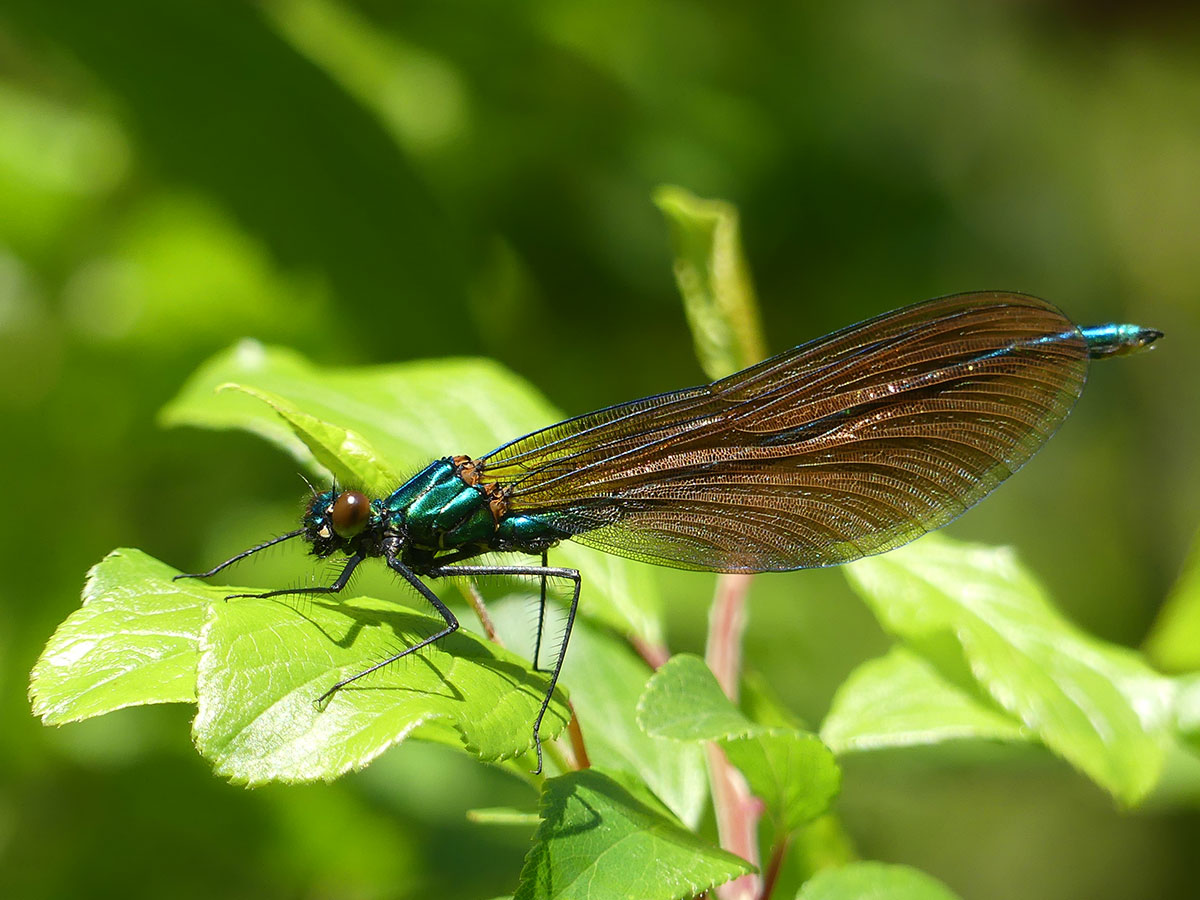
This aptly named, exotic-looking damselfly is our only one with wholly coloured wings. The metallic blue-green male has dark black-brown wings with a blue iridescence. The metallic greenish-bronze female has light brown wings. The dancing, butterfly-like flight is a distinctive feature as it flits over clean, fast-flowing streams.
National status
Locally abundant. Mostly found south-west of a line between Liverpool and Folkestone.
Status in Sussex
Widespread across the county except for the Downs and southwards. Chelmick (1979) noted that this species was “extremely rare on the Weald Clay”. This picture seems to have changed and since 2010, the species having been widely-recorded in the Low Weald particularly in the centre of Sussex. There appears to have been consolidation of distribution across the Wealden Sandstone but the distribution in the High Weald is relatively patchy perhaps partly due to recorder coverage. Since the Millennium, the species has extended its distribution along the Cuckmere and in the east of the county. There have also been a few records on the coastal strip south of the Downs.
Distribution at 1km scale
Historical records
Lucas and Bloomfield (1905) recorded a similar distribution to our current survey data, but the species was considered quite rare in the Hastings area in the 1880s (Dannreuther 1939). N. Moore (in Chelmick 1979) thought it to be “fairly common” on the tributaries of the River Brede but our data suggest it has either declined or is under-recorded there.
Flight times
Late May - early September though with some indication of the flight season now extending later into autumn.
Phenology (adult)
1 / 1
Beautiful Demoiselle habitat at Woods Mill Photo: Fran Southgate
Habitat
Fast-flowing water with a stony bottom and abundant bankside vegetation, typically alders.
Conservation
This species is highly sensitive to pollution, hence its patchy distribution across the county. The Low Weald, where the characteristic small fields and tree-lined streams are still in evidence, is its stronghold. However, the species does need open, sunny glades so neglected riverbanks, where the overhanging vegetation has taken over completely, are unsuitable. The species has been lost where more intensive farming has developed.
Similar species
The only confusion species is the Banded Demoiselle. For details on separating the two species - see under that species.
This aptly named, exotic-looking damselfly is our only one with wholly coloured wings. The metallic blue-green male has dark black-brown wings with a blue iridescence. The metallic greenish-bronze female has light brown wings. The dancing, butterfly-like flight is a distinctive feature as it flits over clean, fast-flowing streams.
1 / 4
Male Photo: Simon Linington
2 / 4
Female Photo: Simon Linington
3 / 4
Mating pair Photo: David Sadler
4 / 4
Young male Photo: Simon Linington
National status
Locally abundant. Mostly found south-west of a line between Liverpool and Folkestone.
Status in Sussex
Widespread across the county except for the Downs and southwards. Chelmick (1979) noted that this species was “extremely rare on the Weald Clay”. This picture seems to have changed and since 2010, the species having been widely-recorded in the Low Weald particularly in the centre of Sussex. There appears to have been consolidation of distribution across the Wealden Sandstone but the distribution in the High Weald is relatively patchy perhaps partly due to recorder coverage. Since the Millennium, the species has extended its distribution along the Cuckmere and in the east of the county. There have also been a few records on the coastal strip south of the Downs.
Distribution at 1km scale
Historical records
Lucas and Bloomfield (1905) recorded a similar distribution to our current survey data, but the species was considered quite rare in the Hastings area in the 1880s (Dannreuther 1939). N. Moore (in Chelmick 1979) thought it to be “fairly common” on the tributaries of the River Brede but our data suggest it has either declined or is under-recorded there.
Flight times
Late May - early September though with some indication of the flight season now extending later into autumn.
Phenology (adult)
1 / 1
Beautiful Demoiselle habitat at Woods Mill Photo: Fran Southgate
Habitat
Fast-flowing water with a stony bottom and abundant bankside vegetation, typically alders.
Conservation
This species is highly sensitive to pollution, hence its patchy distribution across the county. The Low Weald, where the characteristic small fields and tree-lined streams are still in evidence, is its stronghold. However, the species does need open, sunny glades so neglected riverbanks, where the overhanging vegetation has taken over completely, are unsuitable. The species has been lost where more intensive farming has developed.
Similar species
The only confusion species is the Banded Demoiselle. For details on separating the two species - see under that species.


-Beautiful-Demoiselle.jpg)